

OpenAI just blinked in the agentic commerce race. According to The Information, the company is walking back its "Instant Checkout" feature — the ambition to let users buy products directly inside ChatGPT. Low purchase completion rates and the sheer operational weight of managing live pricing, inventory, refunds, fraud, and tax compliance proved too much. For now, users will be routed to third-party apps to complete purchases.
Shares in Expedia and Tripadvisor rose 8% and 13% respectively on the news. TD Cowen analysts called it a "stunning admission."
It's tempting to read this as a retreat — as evidence that AI and commerce don't mix. That would be a catastrophic misreading. What OpenAI discovered is not that agentic shopping doesn't work. It discovered that owning the entire transaction stack is fiendishly hard. The ambition was right. The architecture was wrong.
For Amazon sellers, Shopify merchants, and the brands building on top of the world's great marketplaces, this is not a stay of execution. It's a starting pistol.
The size of the prize
Before dismissing this as another over-hyped AI trend, consider what the analysts have actually modelled.
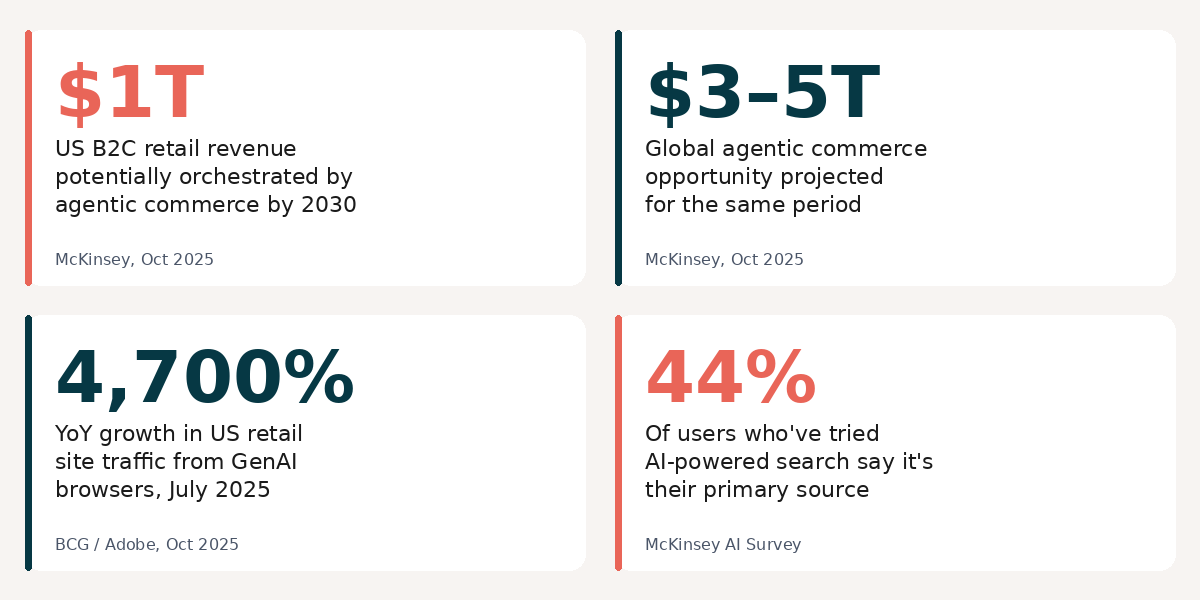
These are not projections from optimistic startups. They're based on adoption rate modelling and real transaction data — and they describe a shift with the breadth of impact of the e-commerce revolution, but moving faster, because agents can traverse the same digital paths to purchase as humans without needing to be taught from scratch.
There's a signal buried in this data that should arrest every seller's attention: users arriving at retail sites via AI agents are not passive browsers. They are 10% more engaged than traditional visitors, spend 32% more time on site, browse 10% more pages, and have a 27% lower bounce rate. These are buyers with intent — already filtered through an intelligent recommendation layer before they even arrive.
What OpenAI actually learned
OpenAI's Instant Checkout launched in September 2025 alongside Shopify, with Walmart and Target following in a wave of institutional confidence. But two uncomfortable truths surfaced quickly.
First: users were happy to browse inside ChatGPT, but not to buy. Second: the infrastructure problem was brutal. Live pricing, accurate stock levels, refund flows, fraud prevention, tax compliance — this is not a problem a language model can reason its way around. Every failed transaction erodes trust in the entire interface, and OpenAI was not positioned to fix that alone.
What this tells us is something important about where agentic commerce will actually land: not in a single walled garden controlled by one AI platform, but in a distributed, interoperable layer that sits on top of existing commerce infrastructure. Amazon, Google, Shopify, Visa, Mastercard, and PayPal are all actively building that layer. OpenAI simply discovered it cannot own all of it.
The race is not to control the checkout. The race is to become the brand that agents reliably select.

The particular risk for marketplace sellers
For Amazon and marketplace sellers already operating one layer removed from their end customer, this is not a theoretical risk. It's a structural one that compounds with every passing quarter.
Amazon and Shopify sellers have already accepted a fundamental trade-off: in exchange for access to massive distribution, they've ceded much of the direct customer relationship. Amazon holds the customer data. The storefront carries Amazon's brand equity. The repeat purchase loop runs through Prime, not through the seller.
Agentic commerce doesn't resolve this trade-off — it intensifies it. AI agents prioritise price, user ratings, delivery speed, and real-time inventory over brand familiarity or loyalty. For sellers who compete primarily on category prominence within a marketplace, this is both a threat and an opportunity: agents will select efficiently, and sellers with the strongest data signals will be disproportionately recommended.
The sellers who will be most exposed are those in the middle: strong enough to have built a catalogue, but without the product data discipline, review velocity, or off-platform presence to be reliably surfaced by agents. Getting out of that middle ground — before the agents start making the calls at scale — is the strategic priority.
The three stages of agentic commerce
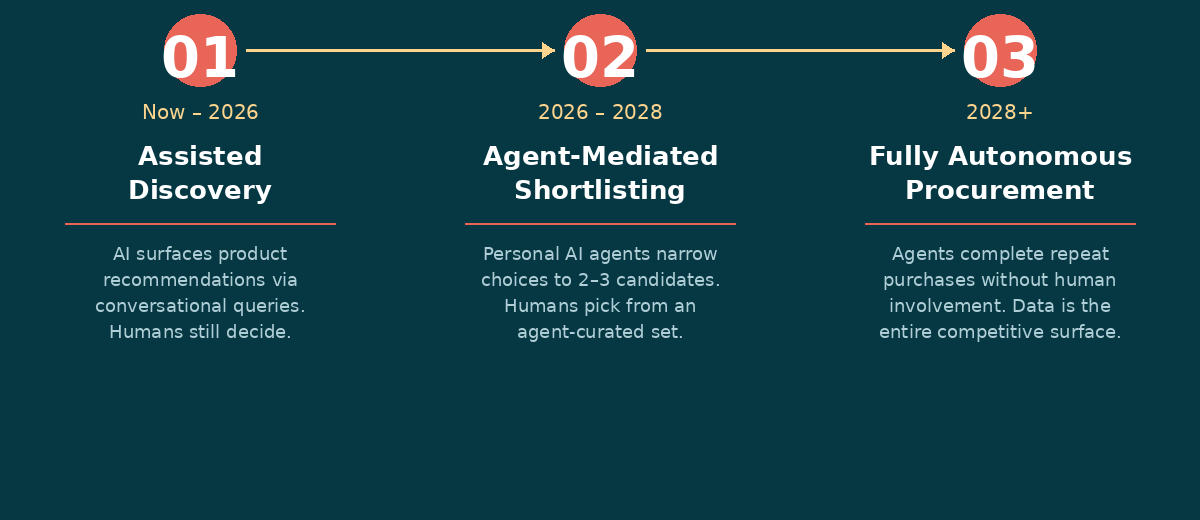
Now – 2026: Assisted discovery
AI surfaces product recommendations in response to conversational queries. Half of all consumers now use AI when searching the internet, and this increasingly carries through to comparing options, assembling baskets, and completing checkout. The old listing optimisation playbook is being rewritten. The shift is from SEO — being found by humans typing keywords — to being recommended by an intelligent system responding to intent.
For Amazon sellers, your ranking signals are evolving. For Shopify merchants, your organic discovery channel is changing faster than most realise.
2026 – 2028: Agent-mediated shortlisting
Personal AI agents, operating with access to a user's preferences, budget, and past behaviour, autonomously narrow a category to two or three candidates. The human makes a final call — but from an agent-curated set.
For marketplace sellers, this stage is the most consequential. Amazon and other platforms are building their own agentic layers on top of existing catalogues. Sellers whose product data is incomplete, whose reviews are thin, or whose listings are not machine-readable will simply not appear in the shortlist. The consideration set is determined before a human ever gets involved.
2028+: Fully autonomous procurement
For repeat, low-consideration purchases — exactly the category where many Amazon and Shopify sellers compete — agents complete transactions without human involvement. Third-party agents work directly with brand or platform agents to finalise purchases, with little to no human input.
The relationship is between the agent and the brand's data. Trust, reliability, and machine-readable product information become the entire competitive surface. Sellers without a presence in this layer simply do not exist to the systems making the decisions.
Six things Amazon and Shopify sellers can do now
1. Treat your product listings as agent briefs, not human copy
Structured, semantically rich, machine-readable content is the foundation of agentic discoverability.
For Amazon sellers, this means going beyond keyword-stuffed titles to complete, accurate attribute data — dimensions, materials, compatibility, use cases — in structured fields. For Shopify merchants, it means clean schema markup, accurate GTINs, and product descriptions written to answer the questions an agent will be asked, not just to persuade a human browser.
2. Build off-platform presence — even if you sell exclusively on marketplaces
Generative AI engines draw heavily on Reddit, YouTube, independent review sites, and community forums when forming recommendations.
For pure-play Amazon or marketplace sellers, this is the single most underleveraged opportunity. Your product being discussed, reviewed, and referenced in authoritative third-party spaces directly affects whether AI models surface you. This doesn't require a full D2C operation — it requires a deliberate presence strategy outside the marketplace walls.
3. Make review generation a system, not an afterthought
AI models weight verified third-party review signals heavily in product recommendations — and for marketplace sellers, reviews are already your primary trust signal.
A sustained, process-driven approach to generating authentic reviews is now a technical requirement for agent discoverability, not just a conversion tactic. Volume and recency both matter. Thin review profiles are an invisible barrier to agent recommendation.
4. Maintain real-time, accurate inventory and pricing data
One of OpenAI's specific failures was data freshness — stale pricing caused transaction failures. Success in agentic commerce requires impeccable product data, competitive pricing, and accurate stock availability at the moment of selection.
For Amazon sellers, this means keeping listings healthy and suppression-free. For Shopify merchants, it means a real-time product feed that any agent integration can trust absolutely.
5. Get onto Shopify's agentic rails if you're not already
Shopify was OpenAI's launch partner for Instant Checkout and is actively building infrastructure that allows agents to tap into its catalogue and build carts across merchants.
For Shopify sellers, ensuring your store is current with platform integrations, your product catalogue is complete, and you're participating in emerging commerce programmes is no longer optional positioning. It's baseline infrastructure for the next era of discovery.
6. Build an identity that agents can find beyond your marketplace listing
For Amazon and marketplace sellers without a direct customer relationship, building a fully autonomous brand agent may not be immediately practical. But the principle holds: the sellers who will win in the agentic era have a legible, consistent, trustworthy identity across the digital ecosystem — not just within a single marketplace.
A website, a content presence, a review footprint, product information that exists and is accurate outside Amazon's walls. Start building that identity now, even if your sales remain marketplace-first.
The window that just opened
OpenAI's retreat from direct checkout is a temporary structural reset, not a verdict on the category. Amazon, Google, Meta, Shopify, Visa, Mastercard, and PayPal are all actively building the infrastructure layer that will make agentic commerce the default mode of product discovery and purchase.
The data is stark: 63% of retailers globally already agree that companies not adopting AI agents risk falling behind within two years. For marketplace sellers whose competitive advantages are already thin — where a ranking algorithm change or a new entrant can reshape the landscape overnight — two years is not a comfortable planning horizon.
The good news is that the foundational work required to compete in the agentic era is not exotic. Clean product data. Strong review signals. Accurate inventory. A presence beyond the marketplace. These are the disciplines that the best marketplace sellers already practise. The difference now is that they're no longer just table stakes for human conversion. They are the selection criteria for the agents that will increasingly decide which products humans ever see.
ChatGPT stumbled in the checkout lane. But for Amazon and Shopify sellers who get their fundamentals right now, that stumble just bought them time they cannot afford to waste.
Every action in this article has a cost. Building off-platform content presence, deepening your review strategy, investing in richer product data, keeping inventory well-stocked so agents never encounter an out-of-stock signal at the moment of selection — none of this happens without working capital behind it.
That's precisely the problem Uncapped was built to solve. As a global fintech purpose-built for e-commerce sellers, Uncapped provides fast, flexible funding to Amazon and Shopify businesses — without the bureaucracy of traditional lenders, without equity dilution, and without being tied to what a single marketplace will allow you to spend it on.
- Decisions in as little as 24 hours, based on your actual sales performance — not credit scores or pitch decks
- Funding that can be deployed across inventory, marketing, content, and off-platform growth — wherever the opportunity is
- An official Amazon Lending partner, accessible directly through Seller Central
- Available to Shopify merchants and multi-channel sellers across Amazon, eBay, Walmart, and beyond
- As your revenue grows, your funding limit grows with it — so you can make bolder decisions at every stage
The agentic commerce era will reward the sellers who moved early — who invested in the infrastructure, the data, and the presence that agents use to make their selections. Uncapped exists to make sure that capital is never the reason you couldn't.
Sources: McKinsey QuantumBlack — The Agentic Commerce Opportunity, Oct 2025 · BCG — Agentic Commerce Is Redefining Retail, Oct 2025 · Futurism — OpenAI's Pivot Into Shopping Has Been a Disaster, Mar 2026
This piece is intended for founders, brand strategists, and commerce leads at Amazon and Shopify businesses navigating the intersection of AI and retail.


